
The automotive industry is navigating a turbulent final quarter of 2025. From rising inventories in the U.S. to the expiry of key EV tax credits and a complex global production outlook, manufacturers and suppliers are facing multiple headwinds at once. This article breaks down the latest dynamics, outlines the key pressure points, and assesses what industry players must do to steer through this “reset” period effectively.
U.S. Market Pressure: Inventory Builds & Softening Demand
Inventory levels spike amid slower buying
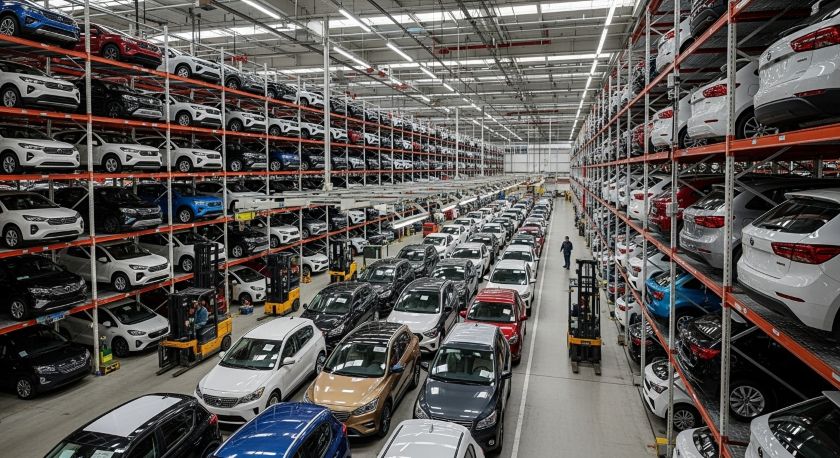
According to data from Cox Automotive / Dealership Guy, new-vehicle supply in the U.S. rose to 2.87 million units in early October—up 4.8% month-on-month and reaching its highest point since Q1 2025. Car Dealership Guy News With many brands now reporting more than 100 days’ worth of inventory, the market is shifting from a supply-constrained environment into one of moderation and excess.
At the same time, the average transaction price climbed to US$46,057 in October—a 2.2% increase year-over-year. J.D. Power+1 The average monthly payment reached US$758, signalling that affordability is under increasing pressure. J.D. Power+1
Sales decline, especially in EV segment
Forecasts from J.D. Power / GlobalData indicate that U.S. new-vehicle retail sales in October 2025 are expected to fall to around 1,051,400 units, a drop of 5.9% compared to October 2024. Total sales (retail + non-retail) are projected at 1,249,800 units, down 6.9%. J.D. Power+1
Critically, the share of EVs in the U.S. market is forecast to revert to about 5.2% of new-vehicle retail sales in October, after reaching a record 12.9% in September. J.D. Power This drop is largely attributed to the expiration of the US federal EV tax credit at the end of September, which pulled forward demand. The Wall Street Journal +1
Implications for dealers and OEMs
With rising inventory, elevated transaction prices, and tightening affordability, OEMs and dealers are under pressure to adjust pricing, incentives, and production planning. The drop in EV share adds another layer of complexity: EVs typically carry higher cost and risk, and their waning share means margins may need readjustment. Retailer profit per unit is expected to be about US$2,295 in October—up by US$97 from a year ago—but aggregate profit is down 2.1%. J.D. Power+1
Global Production Outlook: Mixed Signals
Light-vehicle output adjustments
Global production forecasts are showing mixed signals across regions. According to S&P Global’s light-vehicle production outlook:
-
North America: Slight downward revision of ~7,000 units for 2025, but improvement expected in 2026 (↑85,000 units). S&P Global
-
Japan / South Korea: Japan is seeing an upward revision (≈40,000 units) thanks to new hybrid models; South Korea sees a downgrade of ~14,000 units.
-
South Asia: Upgraded by ~29,000 units in 2025; even more positively expected in 2026 (+92,000 units).
Display and cockpit electronics as a growth engine
Technological components remain a bright spot. The global automotive display market reached 120.96 million units in 1H 2025—up 5.1% year-on-year. Omdia While growth is decelerating compared to past double-digit years, the shift toward “software-defined” cockpits, integrated display systems, and domain controllers is driving structural demand.
Regional disruptions & cyber-risks
In the UK, production at Jaguar Land Rover (JLR) was forced offline in September due to a severe cyberattack, contributing to a 27% year-on-year slump in UK car production in the month, the worst since 1952. The Guardian+1 This highlights that even advanced markets are vulnerable to non-traditional risks like cyber-security and supply-chain shocks.
Strategic Themes Reshaping the Landscape
1. Tax‐credit cliff and EV demand reset
With the end of major EV incentives in the U.S., we’re witnessing a demand pull-forward followed by a reset. Automakers must adapt to lower EV volumes and possibly shift focus toward hybrids and ICE vehicles—at least temporarily. This transition impacts production planning, supply chain commitments, and return-on-investment timelines.
2. Inventory management becomes critical
The buildup of inventory means OEMs and dealers must refine strategies around pricing, promotion, and production alignment. Days-supply metrics rising above 100 days in certain brands suggests a more prolonged moderation period ahead. Swift action is needed to avoid deeper unit cost erosion and margin pressure.
3. Software-defined vehicles & cockpit electronics
As the display and integration segments grow, OEMs and suppliers must pivot from hardware growth to software value. New-generation cockpit systems promise higher differentiation and margin potential and are attracting investment even as vehicle volume growth slows.
4. Global structural shifts & localisation
Tariffs, geopolitical tension, labor cost pressures, and supply chain fragility are driving OEMs to reconsider regional production footprints. For example, some U.S. suppliers are exploring reshoring or near-shoring to mitigate foreign-trade uncertainties. Forvis Mazars
5. Digital and cybersecurity resilience
The JLR cyberattack underscores that automotive is no longer just mechanical engineering—it’s digital systems and services. OEMs must invest more in cybersecurity, supply-chain traceability, software updates, and risk mitigation to manage next-generation vehicle ecosystems.
Outlook and Recommendations for OEMs & Suppliers
For OEMs
-
Revisit production mix: With EV demand adjusting, balancing ICE, hybrids, and EVs is critical for profitability and flexibility.
-
Adopt dynamic pricing tools: Rising inventory and shifting demand require agile price-and-promotion capabilities to maintain market share and margins.
-
Invest in cockpit software: With hardware growth tapering, investing in high-value software and services (connected car, ADAS, cockpit UX) can drive differentiation.
-
Strengthen cybersecurity posture: Production, logistics, and software update mechanisms must become as secure as vehicle powertrains.
For Suppliers and Tier-1/2
-
Position for software-defined vehicles (SDV): Move beyond component supply to service and software offerings, especially for cockpit, domain-controller, and cloud-services architecture.
-
Localize or diversify supply chains: Mitigate tariff risks and production shocks by balancing global footprint and dual-source strategies.
-
Support aftermarket and digital services: With slower volume growth, growth may shift toward lifecycle services, software upgrades, and data monetization.
For Dealers
-
Monitor days-supply and aging inventory: High days-supply means higher risk of discounting and reduced margins.
-
Leverage digital sales channels: With rising payments and consumer pressure, digital finance, subscription models, and online retail become more important.
-
Embrace used vehicles and certified pre-owned: As new-vehicle affordability tightens, used and CPO programs can absorb demand and maintain revenue flow.
What’s Next: Looking Ahead to 2026
The automotive sector is entering what some analysts call a “reset” phase: slower growth, recalibrated demand, and rising costs. As we move into 2026 and beyond, the following trends will be worth watching:
-
The pace of hybrid adoption as interim bridge technology before full EV transitions.
-
Growth of cockpit software and vehicle-as-a-platform (VaaP) business models.
-
Consolidation in EV manufacturing and possibly weaker players exiting the market.
-
Regionalization of production footprints and supply chain resilience measures.
-
Regulatory and safety influences—especially increased focus on cybersecurity, data privacy, and autonomous-driving frameworks.
Final Thoughts
October 2025 highlights several inflection points for the automotive industry: inventory pressure, the impact of incentive expiry on EVs, rising software complexity, global production adjustments, and new types of risk. For automakers, suppliers, and dealers alike, the message is clear: agility, software capability, supply chain resilience, and pricing discipline will define winners in this new era. Those who treat the current slowdown as a structural change—not just a short-term headwind—are best positioned for the next phase of mobility.