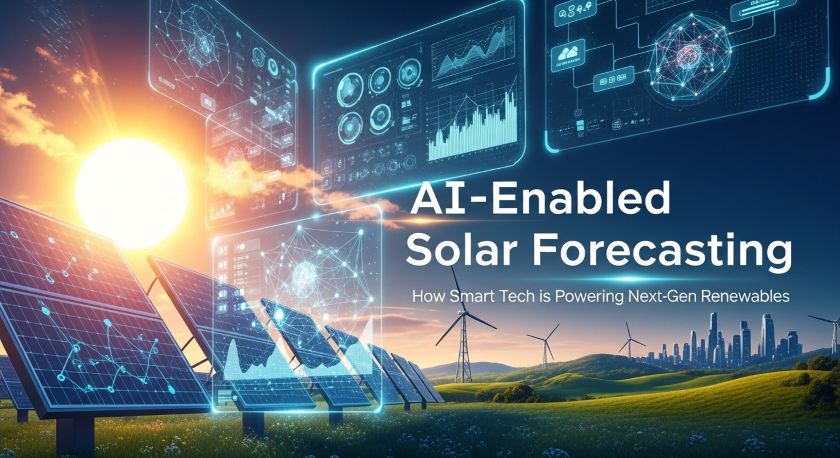

The renewable energy landscape is evolving rapidly in 2025 — not just in terms of capacity additions, but in how clean power is deployed, integrated, and managed. At the heart of this transformation lies artificial intelligence (AI), which is enabling solar-and-storage systems to behave more like reliable dispatchable assets rather than intermittent generators. With global renewable-electricity additions still surging, AI forecasting and smart analytics are becoming essential for grid stability, asset performance and investment optimisation. Deloitte Brazil+2Deloitte Brazil+2
Why forecasting matters now
Historically, one of the biggest constraints for solar and wind has been unpredictability. Clouds roll in, wind drops, output swings — creating challenges for grid operators. But in 2025, AI-driven forecasting tools are making big strides. These tools analyse real-time weather, local generation data, historical performance and grid interactions to predict output and optimise storage dispatch. According to the International Energy Agency (IEA), renewables grew by nearly 6% in 2024, led by accelerated expansion of solar PV and wind. IEA+1
AI forecasting helps mitigate curtailment, reduce the need for backup fossil generation, and improve project return-on-investment. For example, smart solar farms are now routinely using machine-learning models to optimise battery charge/discharge cycles, align with peak tariffs, and coordinate with grid-services.
The technology stack behind smart solar
Several technological advances are converging:
-
Big data & weather modelling: High-resolution satellite, drone and sensor data feed predictive models that anticipate irradiance dips or module performance issues.
-
Storage integration: Instead of treating the battery as an afterthought, AI forecasts output and optimises storage dispatch in real time, balancing generation and load.
-
Digital twins & asset health: Solar farms are deploying digital-twin models that replicate panel-level performance, detect degradation early, and schedule maintenance proactively.
-
Grid-services participation: Projects are increasingly able to bid into markets for frequency, voltage and ancillary services — AI enables this by predicting available surplus generation and scheduling accordingly.
According to a recent trend summary by RatedPower, these capabilities are becoming differentiators for developers, especially in saturated markets. ratedpower.com
Where this matters most
While smart solar-plus-storage is relevant globally, several regions stand out:
-
Emerging markets: Countries in Southeast Asia and Africa, with rapidly growing demand and weaker grid infrastructure, benefit especially from smarter forecasting which mitigates grid instability and improves reliability.
-
Utility-scale plus decentralised hybrid systems: Projects that combine large solar farms with distributed rooftop installations and local storage are able to leverage AI forecasting to optimise supply across multiple nodes.
-
Industrial users and data centres: As AI workloads and electrified industry expand, companies demand 24/7 clean power that matches reliability of fossil plants — AI-forecasted renewables with storage increasingly meet that requirement.
Policy & investment implications
Smart forecasting and digital management are influencing both policy and investment flows:
-
Investors are now valuing asset-performance risk as much as build cost per MW. Projects with AI forecasting and storage command higher valuations and lower financing-costs.
-
Policymakers are recognising the role of digital renewables in grid stability, and some regulatory frameworks are beginning to reward predictive performance and participation in ancillary services markets.
-
According to investment trackers like BloombergNEF, global clean-energy investment hit about US $2.1 trillion in 2024 and is expected to continue rising, with smart technologies like digital twins, AI and forecasting receiving growing shares of funding. BloombergNEF
Risks and challenges
Despite the promise, there are several hurdles:
-
Data-quality & model bias: AI forecasting is only as good as its data. In many emerging markets, incomplete sensor networks or legacy systems hamper accuracy.
-
Cybersecurity & standardisation: With more digital components, cyber-risk enters. Regulators are still catching up on standards for renewable-generation cyber-resilience.
-
Workforce & talent gap: Skilled professionals who understand both clean-energy systems and AI/data science are in short supply. Training and education is lagging.
-
Regulatory lag: Many electricity markets are still designed for fossil plants; enabling renewables-plus-storage to participate fully in ancillary services markets sometimes requires regulatory reform.
What this means for Myanmar and regional players
For countries like Myanmar, the smart-solar narrative offers a roadmap:
-
Prioritise smart-metering, weather-sensor deployment, and digital grid platforms early — this lays the foundation for AI-enabled systems before volumes explode.
-
Pair solar and storage with digital management rather than only focusing on capacity; the next frontier is not just MW installed, but MW optimised.
-
Explore micro-grid clusters for remote or islanded areas, where AI forecasting plus storage improves reliability and reduces dependence on diesel generators.
-
Leverage global investment flows in smart renewables and digital grid infrastructure — this is now becoming as important as panel or battery manufacturing.
Conclusion
2025 may well be remembered as the year when renewables got smarter. The conversation is shifting from “how much capacity can we build?” to “how well can we operate it?” Smart forecasting, AI-driven management and digital integration are becoming essential pieces of the renewable-energy puzzle. For renewables to not only dominate growth but also ensure reliability, resilience and profitability, they must think like utilities — not just builders. The authors of major industry reports agree: solar and wind will continue to lead the next phase of growth, but their true value will come from intelligent operation, not just size. S&P Global+1