Europe has just entered the next phase of its energy transition — the formation of a continental green hydrogen network that connects solar-rich south, wind-rich north, and heavy industrial heartlands in between. In 2025, the EU officially launched multiple cross-border hydrogen corridors linking Spain, France, Germany, and the Netherlands, marking the world’s first large-scale renewable hydrogen backbone designed to replace imported fossil fuels with homegrown clean molecules.
This shift is more than a regional milestone — it’s a template for how renewable power can become renewable fuel, unlocking a new dimension of energy security, industrial competitiveness, and climate progress.
Why hydrogen suddenly matters in 2025
After years of pilot projects, the economics of green hydrogen are finally aligning.
-
Electrolyser costs have fallen by nearly 60% since 2020 due to Chinese manufacturing and EU subsidies.
-
Record solar and wind generation in Spain and the North Sea now produce sustained surpluses of cheap electricity.
-
Carbon border adjustments and fossil fuel import volatility have made low-carbon hydrogen commercially viable for steel, chemicals, and transport.
The result? 2025 is the first year when renewable hydrogen moves from demonstration to deployment. The European Hydrogen Backbone (EHB) — a network of repurposed gas pipelines and new hydrogen infrastructure — aims to stretch 40,000 km by 2040, linking 28 countries and 450 million people.
The structure of Europe’s clean-molecule economy
The EHB initiative connects four main corridors:
-
Iberian Corridor — solar-powered hydrogen from Spain and Portugal flows north via France.
-
North Sea Corridor — offshore wind-powered hydrogen from the Netherlands, Denmark, and Germany.
-
Nordic Corridor — Norway’s hydropower-based hydrogen feeding northern Europe.
-
Eastern & Central Corridor — future extensions through Poland, Austria, and the Balkans.
Together, these create a parallel energy highway system. By converting surplus renewable power into hydrogen and transporting it as gas, Europe can move clean energy thousands of kilometers without overloading its electrical grid.
Solar, wind, and electrolysers — the perfect triangle
The foundation of the hydrogen revolution remains the same three pillars driving renewables globally: solar, wind, and storage.
-
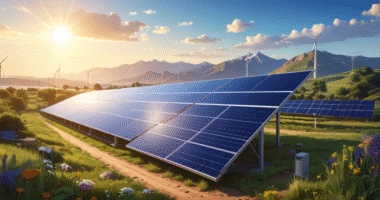
Solar PV is exploding across southern Europe, with Spain surpassing 100 GW installed capacity in 2025.
-
Offshore wind from the North Sea is scaling rapidly, with new floating turbines connecting Ireland, the UK, and Scandinavia.
-
Electrolyser capacity across Europe is projected to exceed 25 GW by end-2025 — enough to produce millions of tons of hydrogen per year.
This combination allows the continent to transform intermittent green power into a stable, storable energy carrier that industries can count on.
Investment and industrial transformation
Clean hydrogen has attracted over €50 billion in new investment this year alone, with support from both the EU Innovation Fund and private sector alliances. Steelmakers like ArcelorMittal, fertilizer giants like Yara, and automotive companies like BMW are signing long-term offtake deals for green hydrogen and e-fuels.
By coupling industrial decarbonisation with renewable build-out, Europe is positioning itself not only as a climate leader but as the first industrial ecosystem powered by clean molecules.
Policy and infrastructure milestones
The EU’s revised Gas Package mandates that 5% of all hydrogen transported through networks must be renewable by 2030, while national plans in Germany and France aim for 10 GW of domestic electrolyser capacity each. Parallel to pipelines, Europe is funding hydrogen storage caverns, shipping terminals, and hydrogen-ready power plants that can run on blended fuels.
These moves are synchronised with the EU’s REPowerEU goals: cutting fossil gas imports by 60% before 2030, improving grid resilience, and ensuring energy independence after the Ukraine war’s ripple effects.
A global signal — and an opportunity for Asia
Europe’s integrated hydrogen system sends a powerful signal to global markets: renewable energy can now serve as both electricity and fuel.
For Asia — particularly energy-importing nations like Japan, South Korea, and Singapore — this provides a working model for transnational hydrogen trade.
Even developing countries such as Myanmar, Vietnam, and Indonesia can take lessons: solar-abundant regions can export clean molecules to industrial centers instead of relying solely on domestic grids.
Environmental and circular economy gains
Hydrogen’s rise also brings attention to sustainability challenges — water use, materials recycling, and electrolyser life cycles. Yet these are now part of the circular economy vision: desalination powered by solar, recovery of platinum-group metals, and integration of battery storage with electrolyser systems.
In addition, hydrogen pipelines are designed for repurposing — meaning today’s fossil infrastructure becomes tomorrow’s clean-energy asset, lowering both emissions and costs.
The road to 2030 and beyond
If the current trajectory holds, by 2030 Europe could supply 20 million tons of renewable hydrogen annually, covering 15% of its total energy consumption. This would cut emissions by over 300 million tons of CO₂ each year and create more than a million new jobs across manufacturing, logistics, and digital energy services.
For the rest of the world, the 2025 European hydrogen push represents a crucial inflection point: renewable energy is no longer limited by sunshine hours or wind speeds — it’s now a global commodity that can be produced, stored, shipped, and consumed anywhere.
Europe’s green hydrogen network proves that the future of renewables lies not just in electrons, but in molecules — clean, transportable, and infinitely scalable.