The renewable energy sector is experiencing a pivotal moment in 2025. As clean-energy technologies mature and markets evolve, the narrative moves beyond “just building more solar panels” to “integrating, sustaining, and optimizing” systems at scale. Growth remains strong—but the nature of growth is shifting.
Expansion continues — but with evolving dynamics
According to the International Energy Agency (IEA), global renewable-electricity capacity is projected to increase by almost 4,600 GW between 2025 and 2030—about double the deployment seen in the prior five-year period. IEA+1 In the first half of 2025, investments into renewables reached a record US$386 billion—up 10 % year-on-year. BloombergNEF+1
What’s shifting:
-
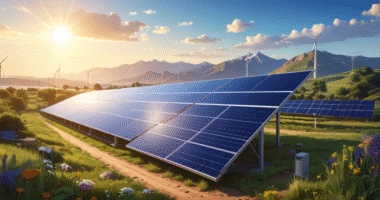
Solar photovoltaics (PV) lead the growth, making up nearly 80 % of new renewable-electricity additions in the coming years. IEA+1
-
Distributed/rooftop systems (commercial, residential) account for an increasing share—42 % of new PV expansion in one forecast. IEA
-
Big-ticket utility wind/solar projects face headwinds (e.g., permitting delays, supply-chain bottlenecks), while smaller-scale solar and storage are gaining traction. BloombergNEF+1
The net result: while capacity is still being built rapidly, stakeholders are increasingly focused on system integration, asset longevity, and flexible grid operations.
Trend 1: Storage, grid flexibility & 24/7 renewables become mission-critical
One of the most significant shifts in 2025 is the growing importance of storage technologies, demand-side flexibility, and “firm” renewable power. According to the Deloitte Renewable Energy Industry Outlook, advanced storage, hydrogen, and 24/7 renewables are expected to play a major role in the next wave of clean-energy growth. deloitte.com
Why this matters:
-
As solar/wind penetration deepens, intermittency and grid-stability issues become more acute. To overcome that, storage (battery, pumped hydro, long-duration) must scale.
-
Many markets are now moving from simply adding capacity to managing capacity: balancing, forecasting, dispatching, grid-services.
-
The IEA reports that growth in distributed solar paired with storage is stronger in regions with unreliable grids (eg South Africa, Pakistan)—showing that storage is offering resiliency and decentralisation, not just cost savings. IEA
For renewable-energy investors and developers, this means that value is no longer solely in “MW installed” but increasingly in “system value delivered”.
Trend 2: Green hydrogen, Power-to-X & industrial decarbonisation accelerate
While solar and wind remain the dominant “front-line” technologies, 2025 is seeing a clear rise in interest and investment in technologies beyond generation: namely green hydrogen, electrolysis, Power-to-X, and integration of renewables into industrial and transport sectors. This shift is driven by the fact that many sectors (heavy industry, chemicals, shipping) are hard to electrify directly. deloitte.com+1
Key take-aways:
-
Renewables now must not just generate electrons but provide the right form of energy (heat, hydrogen, stored power) when and where needed.
-
The deployment of renewables is being seen as part of industrial strategy—building local manufacturing, supply-chains, and green-job ecosystems. World Economic Forum
-
Emerging markets are taking note: the ability to leapfrog traditional fossil-based systems means that renewables + storage + hydrogen combos are increasingly relevant.
Trend 3: Decentralisation, digitisation & emerging-market leap-frogging
In 2025, we’re witnessing a shift from large-scale, centralised renewable plants to more decentralised models: rooftop PV, community solar, microgrids, energy-sharing, smart grid controls. These models are especially relevant for emerging markets where grid infrastructure is less mature. IEA+1
Why it matters:
-
Decentralised systems reduce dependence on long transmission lines and reduce losses—important in geographies with scattered demand (islands, rural areas).
-
Digitisation (IoT, AI-based energy-management, demand-response) is helping optimise the integration of renewables, storage, and load.
-
For developing nations, the challenge is not just about installing capacity but managing system resilience and cost-effectiveness. Storage plus solar in remote areas can deliver more reliable power faster than building large new fossil-fuel plants.
With global renewable capacity growth expected to be strongest in Asia, Africa, Latin America—not just Europe/North America—the decentralised plus digital model is becoming central. IEA
Trend 4: Transition from deployment to renewal & circular-economy mindset
As the renewable energy build-out accelerates, an emerging challenge is looming: after the initial deployment, systems need to be maintained, replaced, repowered, and recycled. The “asset-lifecycle” era is arriving. One academic study projects that as deployment scales, the replacement phase will soon dominate new installations—especially for PV and wind systems. arXiv
Important implications:
-
Investment decisions need to consider not just “build cost” but “lifecycle cost”, recycling, second-life uses (e.g., battery reuse), and asset health monitoring.
-
Supply-chains and manufacturing need to pivot: it’s not enough to supply for initial deployment; long-term maintenance and repowering create a parallel business stream.
-
For investors, projects that embed lifecycle management, circular-economy thinking, and digital monitoring may offer better long-term returns.
In short: 2025 marks the moment where the industry starts thinking beyond “hey we installed it” to “how do we keep it optimal for decades”.
What this means for business, policy & emerging markets
For developers, investors and policymakers—especially in regions such as Southeast Asia, Africa or Latin America—these trends suggest the following strategic priorities:
-
Build storage and grid-integration capability early, not just capacity. Having big solar farms is less useful if you cannot deliver reliable power when needed.
-
Localise supply chains and manufacturing where possible to avoid import dependencies, tariffs and logistical risks; this is now as much about industrial policy as energy policy.
-
Prioritise digital/grid-services, smart controls and decentralised models: rooftop plus community storage could offer faster deployment and higher resilience than centralised options in certain contexts.
-
Embed circular-economy thinking from the start: think about module/battery lifespans, repowering, recycling, second-life uses—not just “install and forget”.
-
Leverage global investment flows: With clean-energy investments hitting record levels, there are opportunities—but policy certainty, grid access and regulatory frameworks remain key.
For an emerging market like Myanmar (or a similar Southeast Asian country), the message is clear: the opportunity is not just “install solar/wind” but “build a resilient, flexible system around renewables”. That means pairing solar with storage, designing microgrid or hybrid systems for remote areas, building local manufacturing or assembly where possible, and preparing for the asset-management phase not just the build phase.
Looking ahead: A system-wide transition, not just a technology one
2025 isn’t just another growth year—it’s emerging as a transformation year. The story is evolving from “install more renewables” to “deploy smarter systems, manage assets, integrate across sectors and geographies”. Renewable energy is no longer just a power-sector phenomenon—it’s industrial strategy, it’s infrastructure renewal, it’s part of manufacturing, logistics, digital services and circular economy.
As the IEA suggests, the coming period will see renewables not just being added—but scaled and embedded. IEA+1
The winners will be those who recognise that the growth model has matured. It’s no longer about being ‘first to install’; it’s about being ‘first to optimise’. For every project developer, policymaker and investor in the renewable-energy field, that means thinking beyond MWs and turbines—to systems, value chains and sustainability.
Updated on October 28, 2025