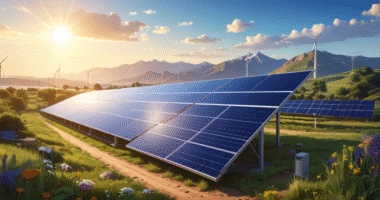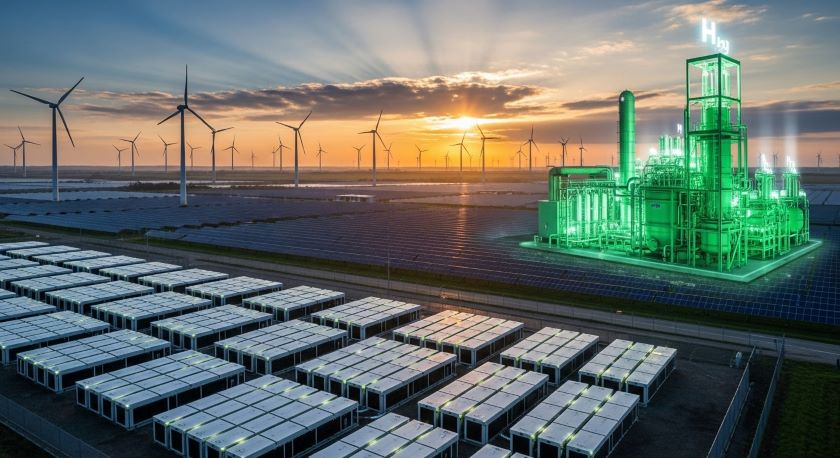

The global renewable‐energy sector is entering a pivotal phase in 2025, driven by surging investment, technology breakthroughs, and policy shifts. While the expansion of solar and wind has dominated headlines for years, this year brings renewed focus on storage, green hydrogen, grid resilience, and a structural shift from deployment growth to system renewal.
Growth still on track — even amid headwinds
According to industry outlooks, solar-capacity additions are expected to exceed 38 GW in the U.S. alone by the end of 2024, with battery storage additions projected to reach nearly 15 GW. Deloitte Brazil+2Deloitte+2 Globally, investment into clean energy technologies (renewables, grids, low‐emissions fuels) is forecast to hit some US$2.2 trillion in 2025. BloombergNEF+3World Economic Forum+3BloombergNEF+3 The result: the contribution of renewables (wind, solar, biomass, geothermal, hydro) to overall U.S. energy consumption rose fastest among all sources, with double‐digit growth year-on-year. Business Council for Sustainable Energy
Yet, despite strong momentum, solar and wind face near-term headwinds: supply‐chain disruptions, tariff uncertainty, labour shortages and interconnection delays. Seia+1
In other words: deployment continues, but the nature of growth is shifting.
Key Trend 1: Storage & grid flexibility become mission-critical
One of the most striking trends in 2025 is the increasing importance of energy-storage technologies—particularly battery energy storage systems (BESS) and long-duration storage solutions. According to recent research, storage installations are rising as intermittency of solar/wind becomes the main barrier to higher renewable penetration. RatedPower+2World Economic Forum+2
Moreover, many analyses point out that growth is moving from just installing capacity to managing and integrating it reliably: in a fully renewables‐driven system, grid flexibility, demand response, storage and digital controls are essential. Matidor+1
For developing markets such as Southeast Asia (including Myanmar’s region), this means storage cost declines + leap‐frogging digital grid architectures are potential game-changers.
Key Trend 2: Green hydrogen & Power-to-X scale up
While solar and wind remain dominant in capacity, green hydrogen (and broader Power-to-X technologies) are gaining traction in 2025 as a key decarbonisation tool—especially for heavy industrial loads, shipping, and sectors difficult to electrify. RatedPower+1 Many new projects are either announced or entering pilot phase, signalling an emerging value chain in hydrogen production, storage, transport and end-use.
For renewable-energy markets, this means opportunities extend beyond “just build more solar panels” to “build the system around them” (storage, hydrogen, grids).
Key Trend 3: Decentralisation, digitisation & emerging markets
Another major shift is the transition from large-scale, centralised deployment to more decentralised and digitalised models: rooftop solar + microgrids + community storage + smart grid digitalisation. Matidor
Emerging markets in Asia, Africa and Latin America are increasingly leapfrogging traditional fossil infrastructure by adopting renewables + storage from the start. The green energy market size is projected to grow at a CAGR exceeding 8 % from 2025 to 2034 globally. GlobeNewswire For countries like Myanmar, this implies the potential to skip heavy fossil-infrastructure investment and move faster into renewables-plus-storage models.
Key Trend 4: Transitioning from deployment to renewal & sustainability
Fueled by rapid expansion, a new challenge emerges: after the initial build-out phase, the industry must manage long‐term renewal, replacement, recycling of assets (solar panels, wind turbines, batteries) and supply-chain sustainability. Academic modelling indicates the global PV industry may face oscillations in production as expansion gives way to replacement cycles beyond 2030. arXiv
In other words, investment decisions now must factor in life‐cycle costs, component reuse, asset health, and grid integration over decades — not just build-fast.
What this means for business, policy and emerging markets
For policymakers and industry stakeholders in emerging regions (like Southeast Asia):
-
Focus on building storage + grid-integration capability early, not just generating capacity.
-
Cultivate local supply-chains for solar, storage and green hydrogen to avoid dependency and tariffs.
-
Consider context-specific models: rooftop + community microgrids might offer faster, more resilient benefit than large utility scale only.
-
Embed circular economy thinking: solar module recycling, battery second‐life, wind-turbine blade reuse matter more.
-
Leverage global investment flows: the surge in clean-energy investment means financing is available, but policy certainty and grid regulation remain pivotal.
Myanmar / Southeast Asia lens
For a country like Myanmar, with high solar potential, grid-connectivity challenges and increasing power demand, the 2025 trends offer a roadmap: deploy solar + wind, but pair it with storage (to manage intermittency and build resilience). Explore “solar + storage + mini-grid” models for remote areas. Monitor green hydrogen/micro-hydrogen hubs as export or heavy-industry fuel options. Strengthen regulatory frameworks for renewables, storage, grid services and community energy.
Conclusion
2025 is not just another growth year for renewables—it’s becoming a transformation year. The narrative shifts from “install more capacity” to “integrate more intelligently”. Technology is moving from simple solar/wind build-out to smart grids, storage, hydrogen, asset lifecycle, and decentralised models. For players in the renewable energy sector—whether developers, policymakers, investors or emerging-market actors—the opportunity lies not only in growth, but in building resilient, flexible, future-proof systems.