
Introduction: The Most Intelligent Year in Laptop History
As we enter the final months of 2025, laptops have evolved from simple computing tools into AI‑powered companions that learn, adapt, and optimize themselves. From powerful Neural Processing Units (NPUs) to energy‑efficient OLED displays and repairable designs, the latest generation offers unprecedented versatility and longevity.
Whether you’re a gamer, a digital creator, or a student, this year’s top laptops prove that the future of computing is smart, portable, and planet‑friendly.
The Rise of AI‑Powered Computing
AI is no longer a premium add‑on — it’s built directly into the processor. Intel, AMD, and Apple have each embedded NPUs that enable laptops to perform real‑time AI tasks locally.
What Does That Mean for You?
-
Instant voice translation and transcription with zero internet delay.
-
Smarter battery optimization that learns your habits and adjusts power use.
-
Noise and background removal for meetings and streaming.
-
Personalized performance tuning — no more manual tweaking.
Notable AI Chips of 2025:
-
Intel Core Ultra 7 200V – Focuses on efficiency and adaptive load balancing.
-
AMD Ryzen AI 9 HX 375 – Known for powerful multitasking and on‑device learning.
-
Apple M3 Pro – Integrates NPU functions directly with GPU acceleration for creative tasks.
The takeaway: the AI revolution has made laptops smarter, quieter, and more power‑efficient than ever.
Displays: The OLED and Mini‑LED Revolution
2025 is the year OLED officially went mainstream. Once reserved for premium devices, it’s now found in mid‑range laptops under $1,000 USD.
Advantages of OLED and Mini‑LED:
-
100 % DCI‑P3 color coverage
-
High contrast ratios for true blacks
-
Better energy management
-
Thinner, lighter chassis designs
For creatives and entertainment enthusiasts, these panels offer cinema‑level visual quality without sacrificing battery life.
Editor’s Pick:
The Dell XPS 14 Plus (2025) boasts a 14.5‑inch 3K OLED screen with 120 Hz refresh rate and color accuracy rivaling professional monitors — all at $1,499 USD.
The Modular and Repairable Future
Sustainability and self‑service repair are now selling points, not afterthoughts. The Framework Laptop 16 ($1,499) has proven you can mix performance with modularity — users can swap CPUs, GPUs, and even I/O ports with simple tools.
Other brands like HP and Lenovo have followed suit, introducing semi‑modular designs that let users upgrade SSDs, memory, and batteries without voiding warranty coverage.
This shift signals a dramatic change in consumer priorities: ownership, longevity, and sustainability now matter as much as performance.
The Return of the Ultraportable Powerhouse
Manufacturers have finally solved the “thin vs. powerful” dilemma. Through advanced cooling and chip efficiency, ultrathin laptops can now rival traditional workstations.
Top Portable Picks of 2025:
| Model | Weight | Battery Life | Price (USD) | Best For |
|---|---|---|---|---|
| MacBook Air M3 | 2.7 lbs | 18 hours | $1,199 | Students / Writers |
| ASUS Zenbook 14 OLED | 2.4 lbs | 15 hours | $1,099 | Professionals / Travelers |
| HP Spectre x360 14 | 3.0 lbs | 16 hours | $1,299 | Hybrid Workers |
| Acer Swift Go 14 OLED | 2.2 lbs | 14 hours | $899 | Budget Buyers |
Each combines battery efficiency, portability, and brilliant displays — ideal for professionals who work anywhere.
Gaming Laptops: Desktop Power, Laptop Form
2025’s gaming laptops are thinner, cooler, and AI‑assisted. Technologies like NVIDIA DLSS 4.0 and AMD FSR 3.5 use machine learning to boost frame rates while maintaining fidelity.
Recommended Models:
-
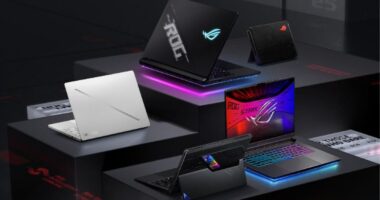
ASUS ROG Zephyrus G14 (2025) – RTX 4070 GPU, 165 Hz QHD screen, $1,899.
-
Lenovo Legion 7i Pro (2025) – RTX 4080, 240 Hz Mini‑LED, $2,199.
-
Razer Blade 15 AI Edition – RTX 4070, 240 Hz OLED, $2,499.
These systems use predictive thermal AI to balance fan noise and performance dynamically — keeping gameplay smooth and systems cool.
Connectivity and Future‑Proof Features
The Wi‑Fi 7 era is officially here. Expect up to 5 Gbps wireless speeds and near‑zero latency for gaming or cloud collaboration.
Additionally, Thunderbolt 5 ports support 80 Gbps data throughput — enough to drive dual 8K displays or external GPUs with ease. Bluetooth 5.4 and 5G‑enabled configurations ensure constant, fast connectivity on the go.
Eco‑Friendly Design and Green Manufacturing
Eco‑conscious laptops are no longer a niche product. Top brands have adopted recycled aluminum, bioplastics, and carbon‑neutral assembly lines.
Examples:
-
Apple MacBook Air M3 – 100 % recycled aluminum shell.
-
Acer Vero Series – Up to 60 % post‑consumer plastic components.
-
HP Spectre x360 14 – Ocean‑bound plastic trackpad surface.
These steps make a tangible environmental difference and ensure your laptop is as responsible as it is capable.
Buying Checklist for 2025
| Category | Minimum Spec | Ideal Spec |
|---|---|---|
| Processor | Intel Core Ultra 5 / Ryzen AI 7 | Core Ultra 7 / Ryzen AI 9 / M3 Pro |
| Memory (RAM) | 16 GB | 32 GB DDR5 |
| Storage | 512 GB NVMe SSD | 1 TB NVMe Gen 4 |
| Display | FHD IPS | 2.8K OLED / Mini‑LED 120 Hz |
| Ports | Thunderbolt 4 / USB‑C | Thunderbolt 5 / HDMI 2.1 |
| Battery | 10 hours | 15 hours + |
| Weight | < 3.5 lbs | < 2.8 lbs |
A future‑proof purchase should balance raw performance with repairability, display quality, and battery efficiency.
Expert Advice: Why You Should Wait for AI‑Optimized Software
Although the hardware is ready, software developers are still catching up. Adobe, Microsoft, and DaVinci Resolve are rolling out updates that utilize NPUs for AI‑accelerated rendering, background removal, and real‑time effects.
If you buy a 2025 laptop with NPU capabilities now, it’ll grow more powerful over time — as more software begins leveraging these cores.
Conclusion: Smarter Choices for a Smarter Generation
The laptops of 2025 aren’t just faster; they’re intuitive, sustainable, and built to evolve. Whether your priority is battery life, modularity, or raw power, this year’s lineup has something tailored for every workflow.
With AI at the heart of every modern chip, your next laptop won’t just run your software — it will learn from you, anticipate your needs, and redefine what “personal computing” truly means.