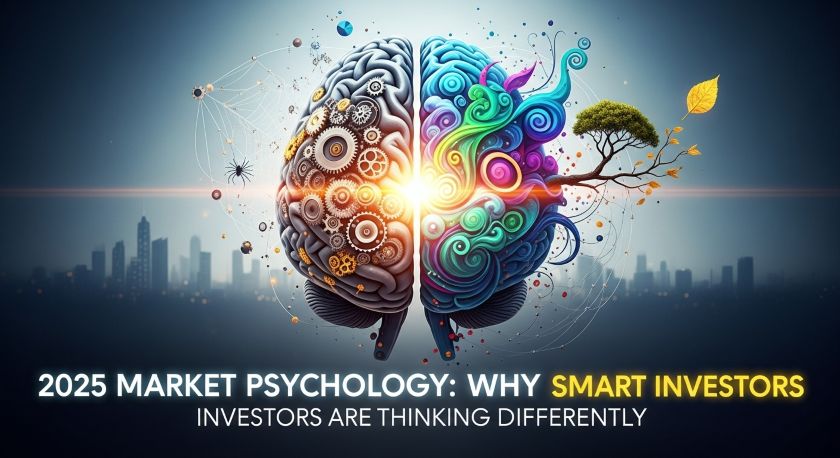

Beyond numbers — the emotional era of investing
As we enter the final months of 2025, financial markets are no longer driven purely by data, earnings, or growth projections. Instead, sentiment and psychology are shaping price trends more than ever. The world’s major investment houses — from Goldman Sachs to BlackRock — agree that the post-pandemic bull market has matured into a behavioral cycle. According to a recent BlackRock outlook, investors are now “anchoring less on economic data and more on confidence signals and perceived stability.”
The result? Market moves are sharper, sentiment turns faster, and rational investing has become emotional investing.
The environment of rising yields, sticky inflation, and inconsistent growth has pushed investors toward “comfort assets” — sectors or regions that feel safer, even if fundamentals are weaker. Understanding these behavioral shifts isn’t just academic; it’s essential for protecting and growing portfolios in 2025’s volatile equilibrium.
1. Herd behavior and “safety illusions”
Every investment cycle has its comfort zones. In 2025, that comfort has shifted toward mega-cap technology, U.S. Treasuries, and cash-like funds. Yet the safety illusion can be costly.
Goldman Sachs data shows record inflows into money-market funds, surpassing $6 trillion globally, as retail and institutional investors retreat to yield-bearing cash. But if rates begin to normalize in 2026, many will miss the rebound in risk assets.
The key insight: herd behavior isn’t risk-free — it’s risk deferred.
Investors should recognize when they’re following consensus rather than conviction. True safety in 2025 comes not from hiding in cash, but from diversification into real-assets, global equities, and inflation-resilient sectors.
Practical takeaway
-
Diversify income sources: mix dividends, bond coupons, and infrastructure yields.
-
Watch fund flows — they often signal when “crowds” are too heavy on one side.
-
Replace emotional comfort with factual conviction.
2. Global optimism fatigue — the rise of realism
In 2020–2023, optimism fueled markets: AI, green energy, crypto, and post-pandemic growth stories. By 2025, optimism fatigue is spreading. Investors are still hopeful, but more cautious, preferring measured exposure over full risk.
A Morgan Stanley study notes that 68 % of global investors now prioritize “capital preservation” over growth. This realism isn’t bearish — it’s maturity. It means re-allocating toward sectors that perform even in flat economies: infrastructure, healthcare, utilities, and defense.
Strategic move
Consider rebalancing portfolios toward quality value stocks, infrastructure funds, and short-duration fixed income instruments. They may lag in bull runs but outperform when volatility rises.
3. The quiet rise of purpose investing
2025’s investors are no longer chasing trends only for profit. ESG fatigue may have cooled the “green rush,” but a more mature form of purpose investing is emerging.
Funds are pivoting from slogans to measurable outcomes — from vague “sustainability” labels to verifiable climate infrastructure, clean-tech supply chains, and health innovation.
BlackRock’s 2025 report highlights a 22 % year-over-year increase in capital deployed to measurable impact assets such as water management, energy grids, and longevity biotech.
Purpose investing is becoming the bridge between conscience and compounding — proving that social good and financial performance can align when executed with discipline.
How to capture it
-
Invest through thematic ETFs targeting clean infrastructure, water, longevity, or health tech.
-
Focus on funds with transparent metrics and audited ESG performance.
-
Balance emotion (purpose) with evidence (returns).
4. The emotional side of technology investing
No sector illustrates psychology better than technology.
AI, semiconductor, and cloud stocks have been the emotional core of global markets since 2023. But as valuations stretched, corrections became more sentiment-driven than earnings-based.
For example, when Nvidia or TSMC announce new AI-chip roadmaps, retail and institutional investors react instantly — sometimes before financial implications are clear. The “fear of missing the next AI boom” drives volatility.
For investors, the lesson is to separate technological inevitability from valuation vulnerability. AI will reshape the world — but that doesn’t mean every AI stock will outperform.
Tactics
-
Maintain exposure to innovation (AI, quantum computing, robotics) via diversified funds rather than single names.
-
Apply valuation discipline — growth at a reasonable price (GARP).
-
Don’t let emotion define allocation size.
5. Contrarian patience — the rarest edge
Patience has become a contrarian strategy in 2025.
The speed of modern markets — driven by algorithmic trading, 24/7 media, and emotional contagion — tempts investors to act constantly. Yet long-term data shows that patient investors still outperform over 3- to 5-year horizons.
In volatile years like 2025, simply holding quality positions through noise can be a superpower.
According to J.P. Morgan Asset Management, missing just the 10 best trading days in a decade can cut total returns by over 50 %. In other words, the emotional urge to “wait for clarity” often means waiting forever.
The smarter mindset
-
Re-commit to your investment plan instead of constantly re-inventing it.
-
Use volatility to accumulate — not to retreat.
-
Measure success in years, not headlines.
6. Building resilience through psychology awareness
Behavioral finance is no longer optional knowledge. Recognizing your own biases — anchoring, confirmation, and loss aversion — directly improves portfolio returns.
In 2025, professional investors are integrating psychological metrics into asset-allocation models. Hedge funds and wealth managers now use “sentiment risk indicators” derived from media tone, Reddit activity, and fund flows to calibrate exposure.
For individuals, it’s simpler: awareness reduces reaction.
Before every major decision, ask: Is this logic or emotion?
That question alone can save thousands.
7. The next frontier: mental diversification
Traditional diversification spreads assets; mental diversification spreads perspective.
In an era of nonstop data, the real competitive edge may be emotional balance.
Investors who cultivate detachment — through education, reflection, or even mindfulness — often make clearer, faster, and less biased decisions.
The future of investing may depend not only on better data but also on better discipline.