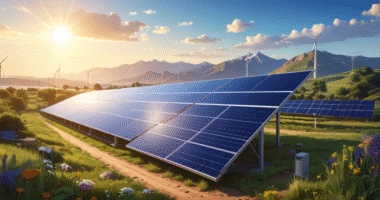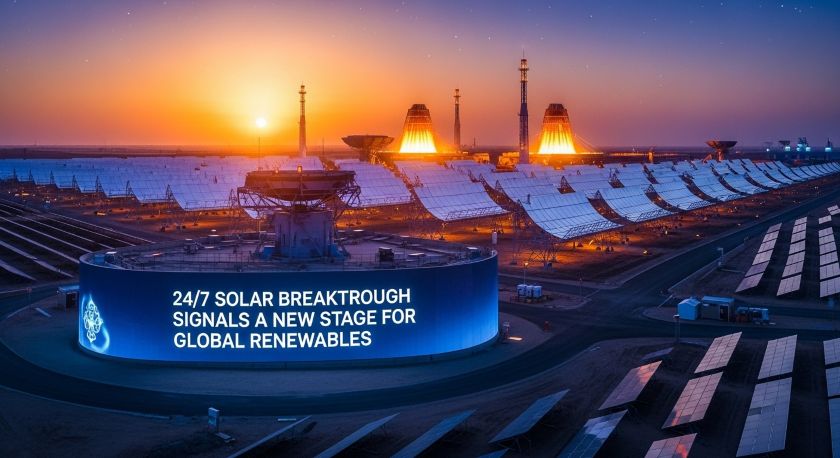

The renewable energy transition just got a real-world stress test — and passed. In late October 2025, Abu Dhabi launched what is being called the world’s first gigascale solar project designed to deliver power 24/7 by pairing massive PV capacity with utility-scale battery storage. The goal isn’t only to make solar cheaper — that’s already happening — but to make solar reliable at night, something utilities and data-center operators have been asking for as AI workloads explode. This single project is an early glimpse of how future grids in hot, fast-growing regions (Middle East, ASEAN, Africa) can run mostly on renewables without sacrificing stability. The Times of India+2IEA+2
Why this project matters more than its size
Around the world, we’ve seen huge solar parks before — but most of them still depend on gas or coal for night-time balancing. Abu Dhabi’s model is different: solar + very large batteries + 24/7 delivery contract. That combination answers the biggest criticism of solar: “what happens after sunset?” Now, with multi-hour storage stacked behind PV, the plant can feed power to the grid even when the sun is gone, making renewables behave more like firm power. It also directly targets a new demand driver — AI data centers and electrified industry — which require stable power, not just cheap power. The Times of India+1
Global context: 2025 is a record year — but grids are the bottleneck
The IEA’s Renewables 2025 report shows the world is on track to add 4,600 GW of renewable power between 2025 and 2030, roughly doubling the build-out of the previous five years. Solar alone is taking almost 80 % of that expansion, thanks to low module prices and fast permitting in many markets. At the same time, 2025 clean-energy investment is expected to hit $2.2 trillion, dwarfing fossil spending. Yet the IEA also warns that grid investment (about $400 billion/year) is lagging behind generation — so projects like Abu Dhabi’s, which come with built-in storage and grid-support capability, are exactly what the market needs. Reuters+3IEA+3IEA+3
The storage super-cycle
Battery energy storage systems (BESS) are now moving from “nice add-on” to “standard component” of large solar and wind projects. IRENA and IEA both note that 2024–2025 storage additions almost doubled year-on-year, and new analyses say global stationary battery capacity has to reach 700–900 GW by 2030 to keep up with renewables. This is why Abu Dhabi’s 24/7 concept is so important: it proves that round-the-clock renewable power is no longer theory — it’s a bankable project archetype. Expect to see copycat projects in Saudi Arabia, Singapore’s industrial zones, and even ASEAN cross-border power platforms. coalition.irena.org+1
Hydrogen-ready, Asia-ready
Running solar 24/7 is only half the story. Across Asia and the Middle East, 2025 is also the year of hydrogen power pilots — integrated projects that make hydrogen from surplus renewables, store it, and feed it back to the grid or to industry. These pilots, from the Gulf to Southeast Asia, are testing one big hypothesis: can renewables supply both electricity and fuel? Current projects suggest yes — but they still need cheaper electrolysers and clearer offtake rules. Abu Dhabi’s model is compatible with this future: once you already have oversized clean power plus storage, adding hydrogen becomes a logical second layer. Power Gen Advancement+1
Lesson for emerging markets (Myanmar, ASEAN power-islands)
For markets with fast-rising demand, weak grids and plenty of sun, the Abu Dhabi project is basically a blueprint:
-
build large solar where land + irradiation are good;
-
pair it with multi-hour BESS to avoid evening blackouts;
-
design for 24/7 delivery so industrial zones and data centers can rely on it;
-
then, in phase 2, add hydrogen or flexible CCGT that’s “hydrogen-ready” like the 670 MW Singapore project announced this week. Energy-Storage.News
This phased model is more realistic than trying to build a perfect 100 % renewable grid in one shot.
What comes next
The bigger trend behind this project is clear: renewables are moving from “cheap energy, when available” to “reliable energy, on demand.” To keep the momentum:
-
More storage tenders — especially 4–8 hour systems to cover the evening peak.
-
Grid-modernisation spending to match the $2.2 trillion going into renewables. Without it, projects will queue up at interconnection.
-
Circular thinking — batteries, inverters and panels deployed now will start hitting replacement windows in the 2030s, and today’s developers can win future business by building recycling and second-life pathways in from the start.
-
Regional power-sharing—the ASEAN Power Grid and GCC interconnectors will make 24/7 solar cheaper because you can move excess to where the sun is gone. Orrick+1