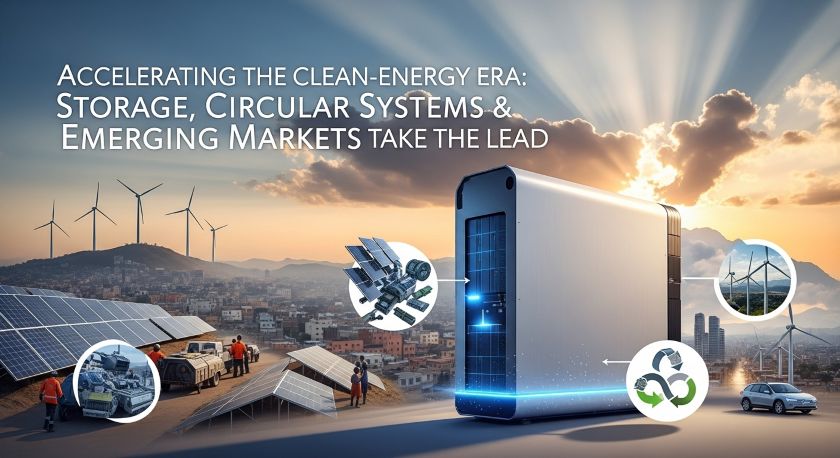

The global clean-energy transition is entering a new chapter in 2025. While the surge in solar- and wind-power build-out dominated headlines in recent years, what’s now gaining prominence is how those technologies are being integrated, managed, and sustained over the long term. The narrative shifts from “install more” to “operate smarter, live longer”.
According to the International Energy Agency (IEA), the latest Renewables 2025 analysis forecasts major growth across electricity, heat and transport sectors — but also spotlights emerging challenges in policy, supply-chain and system integration. IEA Meanwhile, data from the International Renewable Energy Agency (IRENA) show that renewable-energy capacity additions continue to accelerate globally, underscoring the urgency and scale of the change. IRENA
The changing face of deployment
Until recently, the metric of success in the renewable-energy sector was straightforward: add megawatts. But in 2025 the lens is widening. For example:
-
One report points out that clean-energy investment (including renewables, grids, storage, low-emission fuels) is projected to reach around US $2.2 trillion in 2025 — signalling that scale is hitting maturity and depth. The Renewable Energy Institute+1
-
Solar PV and wind are still dominating capacity growth, yet issues like grid-saturation, intermittency and storage-integration are now central constraints rather than after-thoughts. to.ratedpower.com+1
What this means: the story is less about “who built the most panels” and more about “who built the system that works reliably for decades”.
Why storage, flexibility & lifecycle matter more
As solar and wind penetration rises, so too does the need for systems that accommodate variability, longevity and responsiveness. Several key dynamics are at play:
-
Storage and long-duration systems are shifting from niche to essential. The S&P Global cleantech report for 2025 emphasises that battery-energy storage systems (BESS) will surpass pumped hydro in installed capacity, signalling a systemic shift. S&P Global
-
Managing assets over time (renewals, repowering, recycling) is increasingly critical. A research paper points out that beyond the deployment phase, a “renewal phase” begins — creating cyclical production and replacement demands. arXiv
-
Decentralised models (rooftop solar, community storage, mini-grids) and digital control (AI, IoT) are gaining traction, especially in emerging markets where infrastructure was less entrenched. World Economic Forum
Together these trends shift value away from mere installation speed toward system value: reliability, cost-effectiveness, longevity, integration.
The rise of emerging markets and decentralisation
The energy transition is no longer a story of just North America and Europe. Emerging regions are now centre-stage, and their dynamics differ in important ways:
-
Many parts of Asia, Africa and Latin America are leap-frogging legacy fossil systems by adopting renewables plus storage from the outset.
-
In these regions, decentralised and hybrid models (solar + storage, micro-grids, local manufacturing and services) make more sense than large-centralised plants alone.
-
Policy and supply-chain strategies that prioritise local content, job creation and resilience are increasingly seen as competitive advantages.
For developers and policymakers in these markets, the message is clear: build with integration and longevity in mind — not just speed of deployment.
Investment & policy – the new battleground
While investment levels are soaring, the competitive dynamics and regulatory landscapes are shifting fast:
-
Countries are now treating clean-energy tech, manufacturing and deployment as strategic industries, not just climate tools. The World Economic Forum identifies “security, cost and jobs” among the core drivers for 2025. World Economic Forum
-
Supply-chain stress — notably around solar-module manufacturing, battery-materials, logistics — is forcing companies and governments to re-think localisation, diversification, and resilience.
-
Policy certainty remains non-uniform. While some jurisdictions prosper, others face delays, permitting bottlenecks or grid-access issues.
The takeaway: winning in 2025 means combining capital, strategy, policy and operations — it’s no longer simply “get the permit and install”.
What this means for system-renewal and circular economy thinking
As the initial rush of installations matures, the sector must pivot toward maintaining, repowering and recycling assets. The renewal phase is becoming an opportunity, not a cost:
-
For PV and wind systems, lifespans and replacement cycles will drive new business models: refurbishment, second-life batteries, recycling of components.
-
Project developers and investors increasingly evaluate lifecycle cost and operational optimisation, not just upfront cost per MW.
-
Integration of digital monitoring, predictive maintenance and grid-services add value over asset lifetime rather than mere capacity.
In short: the future winner isn’t simply “who builds most” but “who builds best—and lasts longest”.
Spotlight: What this means for smaller / remote markets
For smaller and remote markets (e.g., islands, rural electrification or late-stage infrastructure countries):
-
Deploying solar or wind without coupled storage or grid flexibility risks stranded capacity or low reliability.
-
Micro-grids and hybrid systems (solar + storage + digital controls) may offer faster, more resilient solutions compared to purely utilitarian large-scale plants.
-
Local manufacturing, training, and supply-chain resilience matter significantly for cost, timeline and system independence.
-
Asset-management and renewal readiness need to be baked-in at the very earliest planning stage.
For these markets, success will come from integration, localisation and durability—not just “being first”.
Looking ahead: The clean-energy system evolves
The milestone where global renewable-electricity output overtakes coal (first half of 2025) shows that the transition is accelerating, but it also signals a move into system maturity. The next leg of the journey will ask different questions:
-
Can the system provide power reliably 24/7?
-
Can it include heavy-industry, transport, heat as fully as electricity?
-
Can assets be managed economically over decades rather than just installed quickly?
-
Can supply-chains and business models adapt to lifecycle, recycling, service-models and decentralised demand?
When these questions are answered successfully, the clean-energy transition will have moved from build-out to embedded infrastructure.
In 2025 the sector stands at a juncture: growth is still robust, but the nature of value creation is shifting. Savvy stakeholders will recognise that the future doesn’t belong to “fastest installer” but to “smartest operator”.